

BLKOUT
blkout The Commons
BLKOUT · The Commons · v0.2

Building the
commons.
liberation technology for us, by us.

Who do you work with to reach your audience? How well do you know them? Do you trust them? Should you? When they tell you who they are, believe them.

Corporate platforms extract our data, throttle our reach, and decide quarterly whether our communities are worth keeping. Owning the digital space we organise in is the difference between hosting a conversation and renting permission to have one.

Each of our organisations is small; the tools we need are not. Building them alone burns the time the mission needs. Pooling what we build leaves more capacity for the work — and the things we make together belong to all of us.

The commons is the open question of whether we could be stronger together this time, on purpose.

// two minutes, peer to peer

The invitation,
spoken aloud.

Rob Berkeley · two minutes · no pitch.

One reason and one ask, framed by Audre Lorde — we who were not meant to survive. Why the relationship is itself revolutionary; why love has to be rooted in action; what BLKOUT has put up for peer organisations to take and run.

If you prefer reading, the case is below in two reports and a slide deck. If you prefer listening, there's a NotebookLM podcast deep-dive further down. This is the shortest entry point — the kettle's-on version.

// why now

Together
for our users.

At BLKOUT here are three ways we've started to shape our digital space. Without community there is no liberation — Audre Lorde.

01 · Heritage

Ivor's Compass

a life's legacy in a different light.

Seven directions drawn from Ivor Cummings's life, built around commissioned essays from four Black queer writers; AI made a one-day workshop feel like six. The Black queer men it reached — most of whom don't come to our events — answered the question of who we weren't reaching.

compass.blkoutuk.com →
02 · Frame

Critical Frequency

the data doesn't see us.

The systems that commission services run on data — and the data doesn't see Black queer men. Invisibility in a data-driven system is likely to be fatal. Critical Frequency builds the evidence base that doesn't exist: gathered with consent, in our hands.

critical.blkoutuk.com →

03 · Platform

AIvor

an ancestor-guide, and platform anchor.

Named after Ivor Cummings. Not a crisis service, not therapy. A careful, present companion at 2am that holds the space until a human arrives.

blkoutuk.com →

// the picture

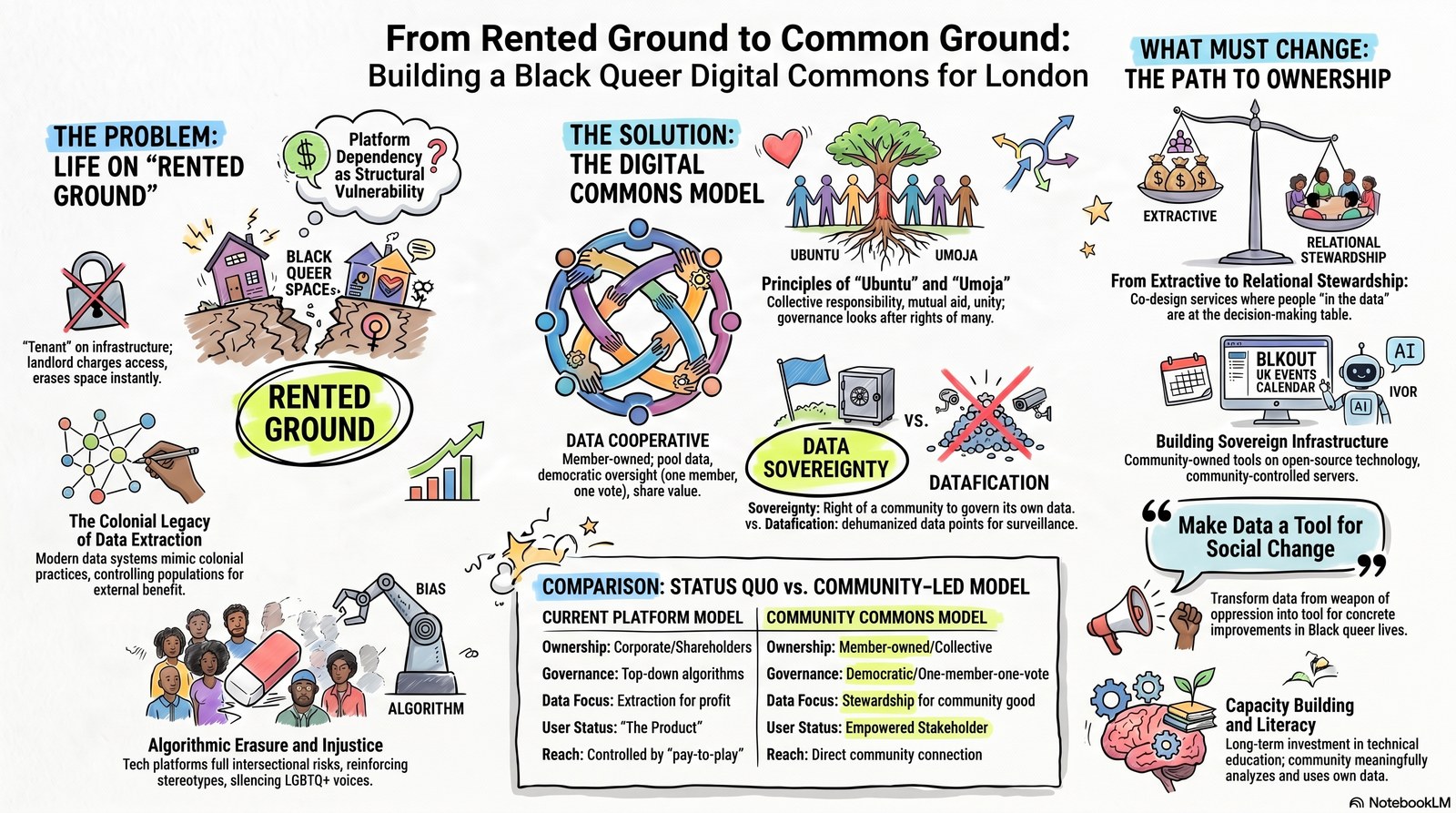
From rented ground
to common ground.

One page. The problem on the left — community life built on infrastructure we don't own. The model in the middle — a data co-operative running on Ubuntu and Umoja. The path on the right — moving from extractive to relational stewardship.

From Rented Ground to Common Ground: Building a Black Queer Digital Commons. Three-column infographic comparing platform dependency, the digital commons solution built on Ubuntu and Umoja principles, and the path to community ownership.
Infographic · A Black Queer Digital Commons

// the offer

Dreamcatcher —
and what it actually offers you.

Dreamcatcher is BLKOUT's AI-tool evaluation engine. It works for us because it knows our tech stack and our core values — and that's also why it can't usefully be opened up as software to other organisations. Your stack and your values aren't ours; they shouldn't be.

what travels isn't the tool, it's the pattern.

What we want to share with peer orgs is how an organisation might use AI tools to strengthen its own ethical decision-making — slowly, in its own context, against its own values. Three ways to engage.

Tier 1 · Read it

The walkthrough

See how it works.

pattern, limits, costs.

A walk-through of how we use Dreamcatcher inside BLKOUT — the five named judges, a real decision worked through, what the tool can't do, and what it costs us to maintain. Honest about the limits.

You can also open the live tool,
but it judges against our values,
not yours.

Read the walkthrough →
Tier 2 · One conversation

Baldwin · Murray · Rustin · Rivera

Apply the pattern.

your context, your values.

A 45-minute call about what AI-assisted ethical decision-making could look like in your stack, against your values. You bring the decision you're stuck on; we bring what we've learned. No follow-up commitment.

We're not productising
Dreamcatcher. We're offering
what we know.

Tick Tier 2 below
Tier 3 · Cohort

Build-your-own

Build your own.

shared learning, not shared software.

A small group of orgs each building their own version — in their own stack, against their own values. Monthly call. We host the first three. The collective layer is the pattern-sharing, not a common platform.

Named for the practice,
not the tool:
building survival programmes
as political education.

Tick Tier 3 below

// background

Read,
listen, decide.

Two short reports, a podcast, and a companion deck. The case for a Black queer digital commons, in long form, in audio, and in slides. Make your own informed choice before the five questions below.

Podcast · NotebookLM Deep Dive · 22 MB

Digital sovereignty for UK Black queer groups.

a conversation generated from the two reports below — listen first if you prefer hearing to reading.

Hosted on Drive · open in new tab →

// the five questions

Five questions.
Then the ask.

None of this is a bid. It's an honest scan of where peer orgs are starting from. Short answers are perfect. If a question doesn't fit your work, skip it. We'll reply within a week. We won't add you to any list without asking.

// the ask Submit your answers and we'll reveal the kit — a two-part downloadable toolkit for taking the method back to your org.

1. Who are your people?

2. Who gets missed?

3. What AI tools are you already using?

4. What data invisibility hurts your work most?

5. If we shared one tool across our orgs next quarter, what would be most useful?

6. A specific question on ticketing.

we're researching how Black queer organisers handle event ticketing, with a view to building shared infrastructure that fits how events actually run. aggregate findings shared back with respondents.

6a. which platform(s) do you currently use?

6b. roughly what proportion of your events are free, subsidised (£1-£5), or full-price?

6c. how many events did you run in the last year, by size? (rough counts)

under 20

20-50

50-100

100-150

150+

6d. rank your top 3 reasons for using your current ticketing platform from this list

Pick the tier(s) you'd want in on

we'll reply within a week. data held by blkout uk only, for this conversation.

// the close

"Small isn't the problem to fix. The connections between us are the point."

— Rob Berkeley · BLKOUT UK